
Ions and Ionic Compounds – Interactive Chemistry Game
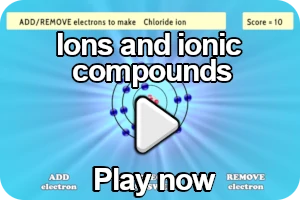
In this interactive chemistry game, you have to convert an atom into an anion or cation and prepare ionic compounds
About the game
This game teaches students how atoms convert to ions by giving away or adding electrons so as to have either 2 or 8 electrons in the outermost orbit which results in a stable and complete outer shell configuration. The game also demonstrates how ionic compounds are formed by combination of cations and anions so that electrical neutrality is achieved.
Grades: 7 & 8
Time: 10 – 15 mins
Skills you will learn: Learn how to convert an atom to an anion by adding electrons, or convert the atom to a cation by removing electrons and the importance of the octet rule. Problem solving skills to solve an ion-cancellation puzzle and then combine the appropriate cations and anions to form an ionic compound.
Teachers Note: This game teaches students about formation of anions and cations and the importance of the octet rule. Students learn to prepare an ionic compound by selecting the correct cations and anions. The game can be used for introducing the topic, classroom revision or independent practice.
Watch the video
How to play
In the first level of the game you will understand how atoms form ions in order to attain the stable octet configuration of the nearest noble gas. You will be able to convert an atom to an anion by adding electrons or to a cation by removing electrons. Click button to add electron to the outermost orbit and convert to anion. To convert atom to cation click on the electron to remove. Play the game with the first 20 elements of the periodic table.
In the second level you solve a small ion cancelling puzzle and then make ionic compounds by combining the correct cations and anions. The total number of positive charges and the total number of negative charges have to be equal in the ionic compound. By playing this level you will understand the naming of ionic compounds and their ionic formulas.
There is no time limit for the levels so you can learn at your own pace.
Games you may like
Atomic structure game: https://scichamp.com/atomic-structure-game/
Metals and non metals game: https://scichamp.com/metals-and-non-metals-game/
States of Matter game: https://scichamp.com/matter-and-states-of-matter-game/