Concave and convex lenses – Notes and Questions & Answers
POSITION OF IMAGE IN CASE OF CONCAVE LENS
| Position of object | Position of image | Size of image | Nature of image |
| At infinity | At focus F1 | Highly diminished, point sized | Virtual and erect |
| Between infinity and optic centre of the lens | Between focus F1 and optic centre of the lens | Diminished | Virtual and erect |
POSITION OF IMAGE IN CASE OF CONVEX LENS
| Position of object | Position of image | Size of image | Nature of image |
| At infinity | At focus F2 | Highly diminished, point sized | Real and inverted |
| Beyond 2F1 | Between F2 and 2 F2 | Diminished | Real and inverted |
| At 2F1 | At 2F2 | Same size | Real and inverted |
| Between F1 and 2F1 | Beyond 2F2 | Magnified | Real and inverted |
| At focus F1 | At infinity | infinitely large | Real and inverted |
| Between F1 and optic centre | Same side as object | Magnified | Virtual and erect |
LENS FORMULA, SIGN CONVENTION, MAGNIFICATION AND POWER OF LENS
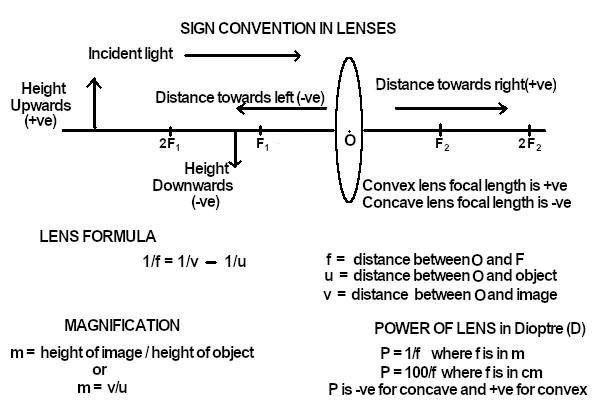
Formula is same for concave and convex lens but sign convention has to be used carefully
| CONCAVE LENS | CONVEX LENS | |
| focal length (f) | Negative (-) | Positive (+) |
| Object distance (u) | Negative (-) (Always placed in the front) | Negative (-) (Always placed in the front) |
| Image distance (v) | Negative (-) (Always forms virtual image) | Positive (+) for real image formed behind the lens Negative (-) for virtual image formed in front of the lens |
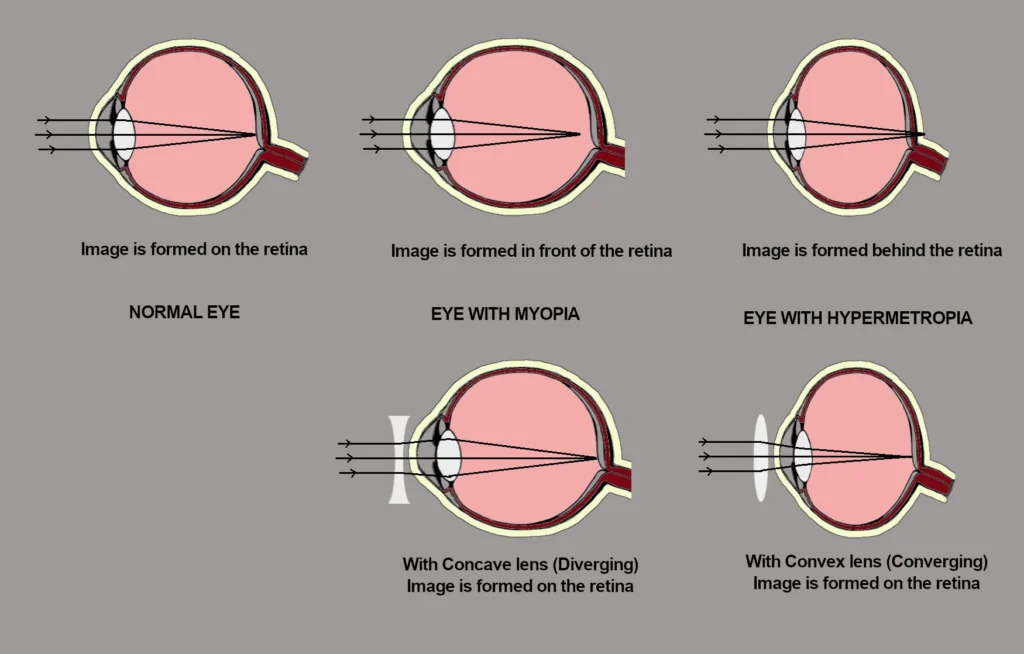
Use of concave and convex lenses as corrective lenses in eye defects
Myopia – Short sight – light focuses short of retina – diverging Concave lens used.
Hypermetropia – Long sight – light focuses long after retina – converging Convex lens used.
MULTIPLE CHOICE QUESTIONS AND ANSWERS
- A ray of light parallel to the principal axis after refraction through a concave lens appears to come from:
- Answer: focal point
- A lens can be considered to be made up of a glass slab and ___?
- Answer: 2 prisms
- The formula for calculating magnification is?
- Answer: image height/object height
- A lens that can form an erect, magnified and virtual image is?
- Answer: convex
- A lens that always forms an erect, diminished and virtual image is?
- Answer: concave
- How is power of lens related to its focal length?
- Answer: reciprocal of
- If one half of a convex lens is covered with black paper, will it produce a complete image?
- Answer: Yes, less intense
- If a convex lens (ref. index 1.5) is placed in water(ref. index 1.33) its focal length will?
- Answer: increase
- If thickness of a convex lens increases its focal length will?
- Answer: decrease
- If the focal length of a lens is negative, the lens is?
- Answer: concave
- If the focal length of a lens is positive, the lens is?
- Answer: convex
- If magnification of a lens is positive then the image formed is?
- Answer: erect and virtual
- If magnification of a lens is negative then the image formed is?
- Answer: inverted and real
- If the focal length of a lens is decreased its power will:
- Answer: increase
- A ray of light passing through a point on the principal axis goes undeviated. The point is:
- Answer: optic centre
- The point at which a convex lens converges all incident rays is called?
- Answer: focal point
- The lens present in a human eye is?
- Answer: convex
- Which lens is used as a magnifying lens?
- Answer: convex
- Which lens is used in a simple microscope?
- Answer: convex
- Peephole in the door of house uses which lens?
- Answer: concave
- Convex lens diverges a beam of light.
- Answer: False
- Concave lens is also known as converging lens.
- Answer: False
- The power of a lens is +1.0 D. Its focal length and type is?
- Answer: +1m, convex
- The power of a lens is +2.0 D. Its focal length and type is?
- Answer: +0.5m, convex
- The power of a lens is -2.0 D. Its focal length and type is?
- Answer: – 0.5 m concave
- The power of a concave lens of focal length 20 cm is?
- Answer: -5D
- The power of a convex lens of focal length 25 cm is?
- Answer: +4D
- The power of a concave lens of focal length 25 cm is?
- Answer: -4D
- Which lens is used to correct myopia?
- Answer: concave
- Which lens is used to correct hypermetropia?
- Answer: convex
- The lens used to correct an eye defect where the image is formed in front of the retina is?
- Answer: concave
- The lens used to correct an eye defect where the image is formed behind the retina is?
- Answer: convex
- The formula for calculating magnification is?
- Answer: image dist./object dist.
- Concave lens has a virtual focus.
- Answer: True
- Which lens is used to correct short-sightedness?
- Answer: concave
- Which lens is used to correct farsightedness?
- Answer: convex
NUMERICAL QUESTIONS
- When an object was placed 15 cm in front of a convex lens its image was formed 15 cm behind it. The focal length of the lens is?
- Answer: f = +7.5 cm, ( u = -15, v = +15 )
- When an object was placed 20 cm in front of a convex lens its image was formed 20 cm behind it. The focal length of the lens is?
- Answer: f = +10 cm, ( u = -20, v = +20)
- When an object was placed 10 cm in front of a convex lens its image was formed 10 cm behind it. The focal length of the lens is?
- Answer: f = +5 cm, ( u = -10, v = +10 )
- When an object was placed 30 cm in front of a convex lens its image was formed 30 cm behind it. The focal length of the lens is?
- Answer: f = +15 cm, ( u = -30, v = +30 )
- A 2 cm tall object is placed 15 cm in front of a convex lens of focal length 10 cm. Find the position of image.
- Answer: v = +30 cm, ( u = -15, f = +10 )
- If an object is placed at a distance of 12 cm in front of a convex lens of focal length of 8 cm, find the position of the image.
- Answer: v = +24 cm, (u = -12, f = +8)
- An object placed 10 cm in front of converging lens forms a real image 15 cm behind it. What is the focal length of the lens?
- Answer: f = +6 cm, (u = -10, v = +15)
- An object placed 4.8 cm in front of a converging lens forms a real image 8 cm behind it. What is the focal length of the lens?
- Answer: f = +3 cm; (u = -4.8, v = +8)
- A convex lens of focal length 10 cm is placed 15 cm in front of a screen. Find object position to get it’s real image on screen?
- Answer: u = -30 cm, (v = +15, f = +10 )
- A convex lens of focal length 4 cm is placed 6 cm in front of a screen. Find object position to get it’s real image on screen?
- Answer: u = -12 cm, (v = +6 , f = +4 )
- If a real inverted image is formed 12 cm behind a convex lens with a focal length of 8 cm. Find the position of the object.
- Answer: u = -24 cm, (v = +12, f = +8 )
- A convex lens of focal length 20 cm is placed 30 cm in front of a screen. Find object position to get it’s real image on screen?
- Answer: u = -60 cm, (v = +30, f = +20 )
- An object is placed 10 cm from a convex lens of focal length 20 cm. Find the position of the image.
- Answer: v = -20 cm, (u = -10 , f = +20)
- An object is placed 5 cm from a convex lens of focal length 10 cm. Find the position of the image.
- Answer: v = -10 cm, (u = -5 , f = +10)
- An object is placed 2.5 cm from a convex lens of focal length 5 cm. Find the position of the image.
- Answer: v = -5 cm; (u = -2.5 , f = +5)
- An object is placed 4 cm from a convex lens of focal length 6 cm. Find the position of the image.
- Answer: v = -12 cm; (u = -4 , f = +6)
- An object is placed 10 cm from a convex lens of focal length 30 cm. Find the position of the image.
- Answer: v = -15 cm; (u = -10 , f = +30)
- An object is placed 7.5 cm from a convex lens of focal length 10 cm. Find the position of the image.
- Answer: v = -30 cm; (u = -7.5, f = +10)
- An object is placed 4.5 cm from a convex lens of focal length 6 cm. Find the position of the image.
- Answer: v = -18 cm; (u = -4.5, f = +6 )
- An object is placed 15 cm from a convex lens of focal length 20 cm. Find the position of the image.
- Answer: v = -60 cm; (u = -15 , f = +20)
- A concave lens has a focal length of 20 cm. At what distance should an object be placed to form an image 15 cm in front of the lens?
- Answer: u = -60 cm; (v = -15 , f = -20)
- A concave lens has a focal length of 15 cm. At what distance should an object be placed to form an image 10 cm in front of the lens?
- Answer: u = -30 cm; (v = -10 , f = -15)
- An object 60 cm from a concave lens gives a virtual image 20 cm in front of the lens. What is the focal length of the lens?
- Answer: f = -30 cm; (u = -60, v = -20 )
- An object is placed 15 cm in front of a concave lens of focal length 10 cm. Find the position of the image.
- Answer: v = -6 cm; (u = -15, f = -10 )
- An object 3 cm from a concave lens gives a virtual image 2 cm in front of the lens. What is the focal length of the lens?
- Answer: f = -6 cm; (u = -3, v = -2 )
- An object 60 cm from a concave lens gives a virtual image 24 cm in front of the lens. What is the focal length of the lens?
- Answer: f = -40 cm; (u = -60, v = -24)
- An object 20 cm from a concave lens gives a virtual image 10 cm in front of the lens. What is the focal length of the lens?
- Answer: f= -20 cm; (u = -20, v = -10)
- An object 30 cm from a concave lens gives a virtual image 15 cm in front of the lens. What is the focal length of the lens?
- Answer: f = -30 cm; (u = -30, v = -15 )