
Basic Electrical Circuits – Notes and Questions & Answers
Basic circuit Questions and Answers
In an electrical cell/battery:
Long line side is +ve positive -| I- short line side is -ve negative
1. Drag in the arrows to show correct direction of flow of electrons in the circuit.
Answer: electrons flow from -ve terminal of battery through the circuit to the +ve terminal of battery.
2. Drag in the arrows to show correct direction of flow of current in the circuit.
Answer: electrons flow from -ve terminal through the circuit to the +ve terminal of battery.
3. Make necessary change to reverse the direction of current in the circuit.
Answer: Click the cell/battery to reverse polarity.
4. Make necessary changes in circuit to make bulb dimmer.
Answer: Add bulb in series.
5. Make necessary changes in circuit to make bulb brighter.
Answer: Replace cell with higher voltage battery.
6. Add a second bulb without decreasing the brightness of the bulbs.
Answer: Add bulb in parallel.
7. Attach an apparatus to measure current in the circuit.
Answer: Attach ammeter in series.
8. Attach an apparatus to measure potential difference across the bulb.
Answer Attach voltmeter in parallel.
9. Make necessary changes to increase the current and voltage reading.
Answer: Replace cell with higher voltage battery.
10. Add an apparatus to control the brightness of the bulb.
Answer: Add variable resistance in series.
11. Make necessary changes to decrease voltage reading in voltmeter.
Answer: Add second bulb or variable resistance.
12. Add an apparatus to control the current in the circuit.
Answer: Add variable resistance in series.
Series Circuit Questions and Answers
- Voltage drops across each resistance in series. Use the equation, V = V1 + V2 + V3 +… to find unknown voltage x.
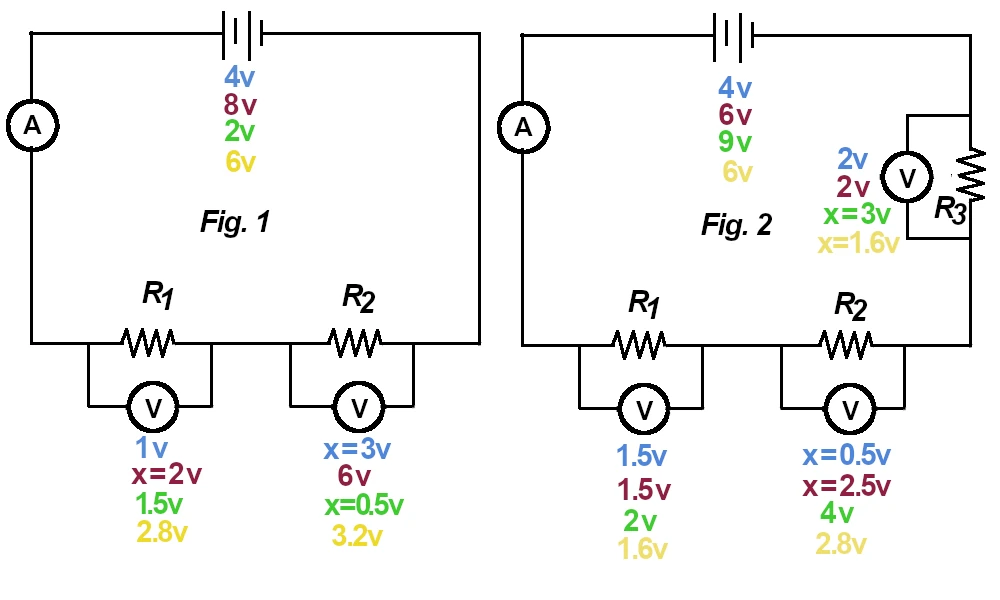
2. To find Equivalent resistance across the circuit use the equation Req = R1 + R2 + R3 ….
- In the circuit given in Fig. 1, if R1 = 2.5 ohm and R2 = 1.5 ohm, what is Req ? Answer: 4 ohm
- In the circuit given in Fig. 1, if R1 = 5 ohm and R2 = 8 ohm, what is Req ? Answer: 13 ohm
- In the circuit given in Fig. 1, if R1 = 3.3 ohm and R2 = 1.5 ohm, what is Req ? Answer: 4.8 ohm
- In the circuit given in Fig. 1, if R1 = 3.4 ohm and R2 = 2.8 ohm, what is Req ? Answer: 6.2 ohm
- In the circuit given in Fig. 2, if R1 = 1.5 ohm, R2 = 0.8 ohm and R3 = 1.7 ohm, what is Req ? Answer: 4 ohm
- In the circuit given in Fig. 2, if R1 = 4.4 ohm, R2 = 1.8 ohm and R3 = 2.3 ohm, what is Req ? Answer: 8.5 ohm
- In the circuit given in Fig. 2, if R1 = 3.3 ohm, R2 = 4.4 ohm and R3 = 5.5 ohm, what is Req ? Answer: 13.2 ohm
- In the circuit given in Fig. 2, if R1 = 2.5 ohm, R2 = 1.6 ohm and R3 = 1.2 ohm, what is Req ? Answer: 5.3 ohm
Parallel Circuit Questions & Answers
- Current get divided as it flows through the branches in the circuit. Use the equation I = I1 + I2 + I3 +… to find unknown current x.
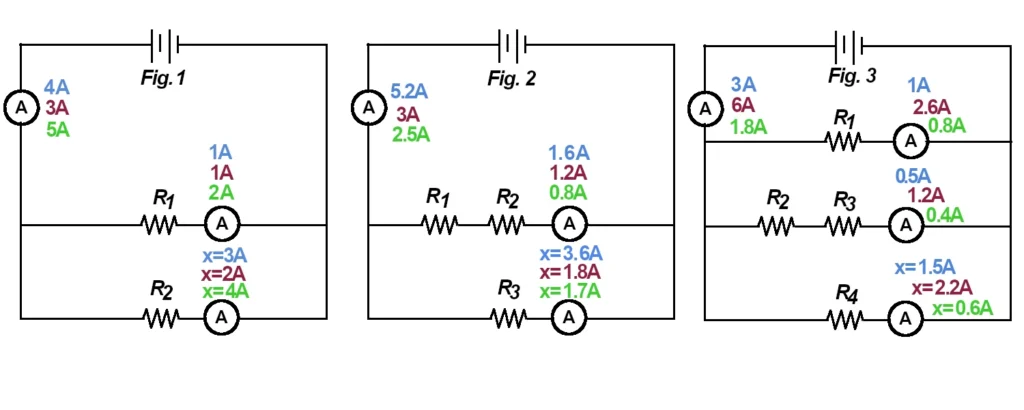
2. To find Equivalent resistance across the circuit use the equation 1/Req = 1/R1 + 1/R2 + 1/R3 ….
- In the circuit given in Fig. 1, if R1 = 1 ohm and R2 = 1 ohm, what is Req ? Answer: 0.5 ohm
- In the circuit given in Fig. 1, if R1 = 3 ohm and R2 = 6 ohm, what is Req ? Answer: 2 ohm
- In the circuit given in Fig. 1, if R1 = 9 ohm and R2 = 9 ohm, what is Req ? Answer: 4.5 ohm
- In the circuit given in Fig. 2, if R1 = 1 ohm, R2 = 3 ohm and R3 = 4 ohm, what is Req ? Answer: 2 ohm
- In the circuit given in Fig. 2, if R1 = 5 ohm, R2 = 5 ohm and R3 = 10 ohm, what is Req ? Answer: 5 ohm
- In the circuit given in Fig. 2, if R1 = 15 ohm, R2 = 15 ohm and R3 = 30 ohm, what is Req ? Answer: 15 ohm
- In the circuit given in Fig. 3, if R1 = 3 ohm, R2 = 3 ohm, R3 = 3 ohm and R4 = 2 ohm, what is Req ? Answer: 1 ohm
- In the circuit given in Fig. 3, if R1 = 5 ohm, R2 = 5 ohm, R3 = 5 ohm and R4 = 5 ohm, what is Req ? Answer: 2 ohm
- In the circuit given in Fig. 3, if R1 = 2 ohm, R2 = 2 ohm, R3 = 2 ohm and R4 = 4 ohm, what is Req ? Answer: 1 ohm
MCQs in Solar electricity level
When there is a break in the path of current, the circuit is called:
Answer: open circuit
In series circuit, each device is connected in such a manner that there is only one path for current to flow.
Answer: True
Series circuit has only one path for electrons to flow.
Answer: True
Formula for Total Series Resistance is ___.
Answer: Rt = R1 + R2 + R3
Batteries are generally connected in:
Answer: series
In series circuit if one bulb goes off, other bulbs will:
Answer: also turn off
Addition of resistors in series circuit increases net resistance.
Answer: True
Addition of resistors in parallel circuit increases net resistance.
Answer: False
Addition of resistors in parallel circuit decreases net resistance because:
Answer: more paths available for flow of current
In a parallel circuit, there are two or more paths for current to flow.
Answer: True
It is preferable to connect bulbs in:
Answer: parallel
In ______ connection total resistance is smaller than the smallest resistance.
Answer: parallel
Total resistance in parallel circuit is:
Answer: 1/Rt = 1/R1 + 1/R2 + 1/R3 +…
In a parallel circuit the branch with lowest resistance has the maximum current flowing.
Answer: True
Voltage in each path of parallel circuit is always the same.
Answer: True
Addition of resistors in a parallel circuit decreases net resistance.
Answer: True
In _____ Circuit, current is same in all parts.
Answer: series
In ______ connection total resistance is larger than the largest resistance.
Answer: series
Copper and aluminium wires are usually employed for electricity transmission because:
Answer: they have low resistance and they are strong
Devices which deliver electricity are called:
Answer: source
Devices which consume electricity are called:
Answer: load
Solar cell converts:
Answer: solar energy to electrical energy
Combination of solar cells forms:
Answer: solar panel
Combination of solar panels forms:
Answer: solar array
Solar cells are used by satellites in space for generation of electricity.
Answer: True
Tungsten is used for making filament of an electric lamp because of:
Answer: high melting point and high resistance
Filament of an electric bulb is made of:
Answer: tungsten
Electric current is flow of ____
Answer: electrons
All wires in an electric circuit should be covered with:
Answer: insulators
Bodies which allow current to pass through them are:
Answer: conductors
The main component of an electric circuit is:
Answer: electric cell
When circuit is closed electric current does not flow.
Answer: False
Human body is _____ of electricity.
Answer: conductor
Electric fuse is used to protect household electric appliances from accidental:
Answer: Large flow of current
Unit of electrical resistance:
Answer: Ohm
Device use to make or break circuit:
Answer: Switch
Path along which electric current flows is called ______
Answer: circuit
Current does not flow in ____ circuit.
Answer: open
In a cell, electrons flow from ___ terminal to ___ terminal.
Answer: negative to positive
Electric cell produces electricity from _____ stored in it.
Answer: chemicals stored in it
A combination of two or more cells is called:
Answer: battery
In a dry cell:
Answer: chemical energy changes to electric energy
Primary cells are used in:
Answer: torches
Secondary cells are used in:
Answer: mobile phones
Dry cell can be reused.
Answer: False
Secondary cell are rechargable.
Answer: True
If two identical bulbs are connected in a series circuit and in a parallel circuit, in which circuit will bulbs be brighter?
Answer: parallel
In a parallel circuit, net resistance _____ as more resistors are added to the circuit.
Answer: decreases
A protective device for breaking an electric circuit is:
Answer: fuse
The current in a series circuit containing two bulbs is:
Answer: same at every place in the circuit
Wires are usually made from copper because:
Answer: copper is a very good conductor of electricity
Two bulbs are connected in a series circuit. If the voltage is increased:
Answer: bulbs get brighter and current increases
Three electric cells of 1.5 volt potential difference each are connected as battery. The voltage of the battery will be:
Answer: 4.5 volt